
How Your Baby's Sleep Really Works: Sleep Pressure & the Body Clock
When we talk about how baby sleep works, there are two biological systems quietly working in the background: sleep pressure and the circadian rhythm, or body clock.
They are two separate systems, but ideally, they work together. When they are aligned, sleep tends to come more easily. When they are not, sleep can become messy. Short naps, frequent night wakings and overtired babies can all be signs that the timing is not quite right.
Let's keep this simple.
Sleep pressure
Sleep pressure is your baby's natural need for sleep building up while they are awake.
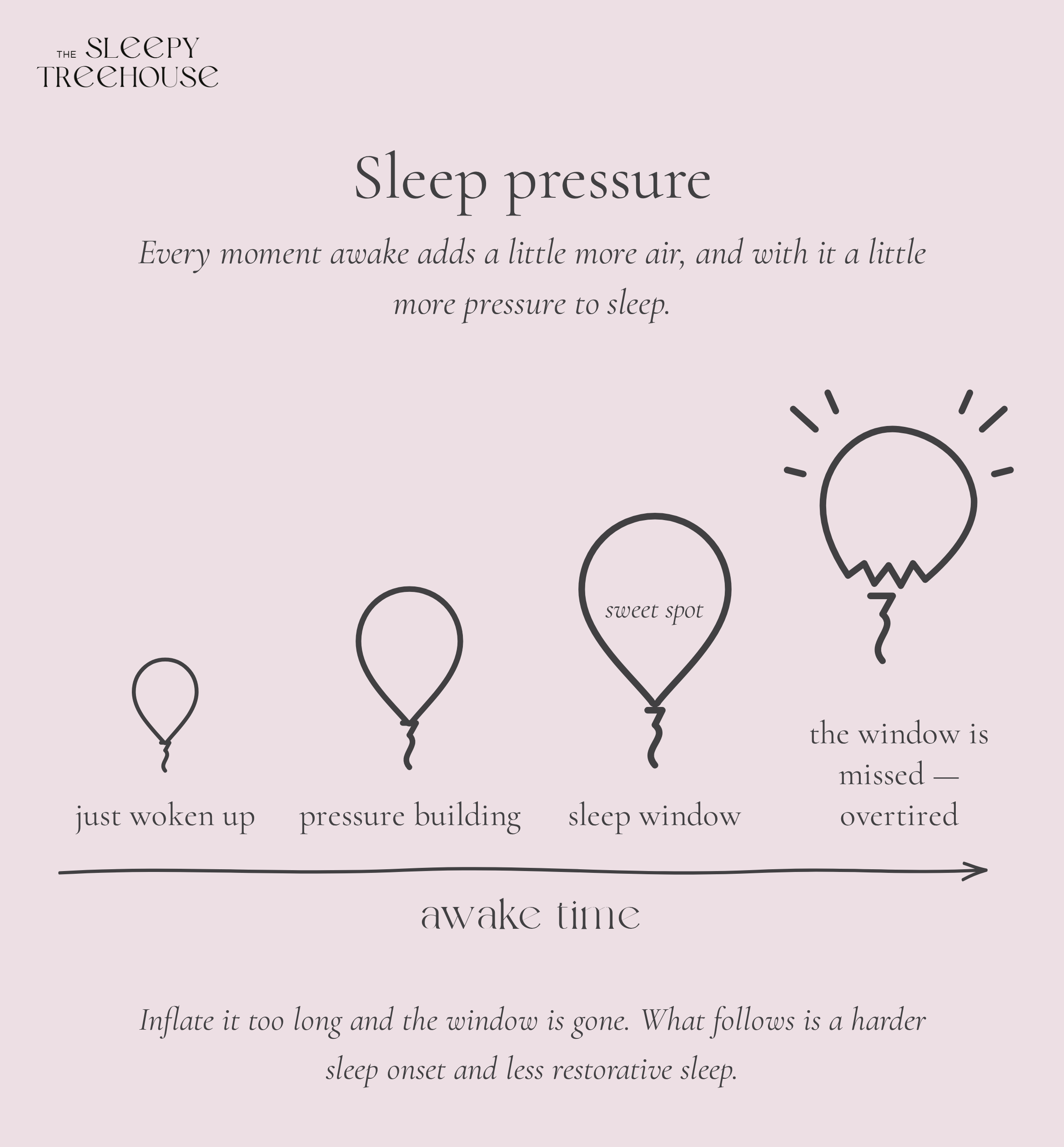
As your baby stays awake, their body slowly builds up the need for sleep, like a balloon being gently inflated. Each moment awake adds a little more air and, with it, a little more pressure to sleep.
But here is the important part.
If the balloon keeps inflating for too long, sleep pressure can become too high and your baby can become overtired.
An overtired baby may still sleep, but that sleep can be lighter, shorter, more fragmented, and less restorative. You can think of this as “junk sleep”. Sleep that takes the edge off the tiredness but does not provide the same quality of rest. Over time, this becomes exhausting and unsustainable for everyone.
Sleep pressure is an automatic biological process. We cannot control it. What parents can do is learn to recognise their baby's early sleep cues and respond before tiredness turns into overtiredness.
Your baby's body clock
The other piece of the puzzle is your baby's circadian rhythm.
This is your baby's internal body clock. It helps regulate when to sleep and wake, as well as feeding, digestion, body temperature, hormones, metabolism, and even mood. It responds strongly to the light and dark cycle and follows a roughly 24-hour rhythm.
Light sends signals to the brain that help promote wakefulness. As the body clock matures, darkness helps signal the release of melatonin, a hormone that prepares the body for sleep.
However, and this is key, babies are not born with a mature body clock.
In the first months of life, sleep and wake signals are irregular and patterns change often because the body clock is still developing. This is why parents often feel like they have finally figured things out, only for everything to change again a few weeks later.
It is not regression.
It is maturation.
Why alignment matters
Sleep tends to work best when these two systems are aligned.
Sleep pressure needs to be high enough to create a need for sleep, but not so high that your baby has already become overtired. At the same time, the body clock needs to be signalling that the body is biologically ready for sleep.
When these two forces align, we find your baby's sleep window.
This is when sleep tends to come more easily. Babies are more likely to fall asleep smoothly and have more settled, restorative sleep.
When they do not align, because of too much awake time, poorly timed naps, or a bedtime that does not match the biological clock, sleep can start to fall apart.
In simple terms
Sleep pressure is the need for sleep that builds while your baby is awake.
The body clock tells you when their body is biologically ready to sleep.
Good sleep depends on both.
Understanding these two forces helps explain why timing matters so much. It is not simply about how long your baby has been awake. It is about recognising your baby's sweet spot, when their need for sleep and their biological clock are working together.
Lights out. Drams on.